
City to roust homeless from shantytown

0624_11.jpg (48031 bytes)By Jan Moller

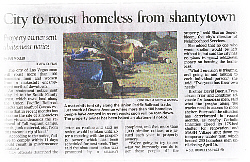
The city of Las Vegas soon will roust more than 100 homeless men and women from a makeshift encampment north of downtown.

An abatement notice sent May 14 to the Smith Family Trust, which owns land along the Union Pacific Railroad tracks just south of Owens Avenue that in recent months has become the site of a homeless shantytown, demands the removal of "all vagrant camps, trash, junk material, etc., from this vacant strip of land."

According to the notice, failure to comply within 11 days could result in misdemeanor citations.

City officials described the letter as routine and said no action would be taken until after a meeting with the property owner, which has been scheduled for next week. They said the abatement notice was prompted by a citizen's complaint, and that more than 1,000 similar notices are issued each year to property owners.

"We're going to try to see what we humanely can do to get these people off the property," said Sharon Segerbloom, the city's director of Neighborhood Services.

She added that no one who wants shelter would be left without it, but said the city has no plans to spend additional money on housing the homeless.

"What I envision is triaging, and going in and talking to each individual person," she said. "Everyone has their own needs."

Brother David Buer, a Franciscan friar and longtime advocate for homeless men, said what the people along the tracks need is access to more shelter. Buer said the situation has deteriorated in recent months, as nearby Catholic Charities closed its 175-bed shelter for renovation and MASH Village shut down its temporary winter tent, which housed 250 homeless men until closing April 16.

"We have less shelter beds than we had a year ago," Buer said. "The Neighborhood Services (department) is trying to make criminals out of the people who had a little bit of compassion and let them stay where they're not bothering anybody."

Buer said rumors of the city's plans to tear down the encampment have prompted dozens of men to leave in recent weeks. But on Friday afternoon, more than two dozen homemade tents remained on the grounds, where a handful of men sought shade in the triple-digit, late-afternoon temperatures.

Max, a Texas native who said he has lived at the site for nearly 10 months, agreed that it should be cleaned up but questioned what would become of the campers. "The only place they can go is into the neighborhood, where the people and the tourists are, and that's when the robbing and stealing starts," he said.

Like others at the camp, Max said he prefers living outdoors over life in a shelter, claiming it's healthier and safer than the cramped conditions provided by local charities.

But Manu Savea, a Hawaii native who has lived outdoors for six years, said that while some homeless people refuse to take advantage of available social services, others would gladly sleep indoors if there was more space in the shelter.

Reprinted from the Review-Journal.